Showing posts with label art criticism. Show all posts

Wednesday, January 30

Did anyone notice these two things?

In the early 2000s, Christian Viveros-Faune wrote art criticism for the New York Press while he codirected the gallery Roebling Hall in Williamsburg. He was the only reason for me to ever pick up that newspaper. Except for the I Saw You classifieds, which have morphed into the better-known Missed Connections on Craigslist. And I lost interest in reading those a long time ago. Back to CVF: I do not recall reading a blog post that mentioned his tenure at the New York Press and the much more obvious appearance of a conflict of interest there.

Spiritual America: just about every photograph in that show was labeled “Exhibition Copy” or something like that. There wasn't a single “original” Richard Prince photograph in that museum—they were all copies that were probably destroyed after the exhibition. (Prince has always produced his photographic work in editions of two.) So here was a major retrospective in a major world museum that, for a large part of the show, displayed facsimiles of the artist’s work. I cannot recall a single review that mentioned this. Is the joke on us now?

Here’s a related story from two years ago, perhaps posted two years too late:

On November 8, 2005, the first photograph to sell for more than a million dollars at auction was sold at Christie’s in New York. Richard Prince’s large Ektacolor print, Untitled (Cowboy), an edition of two from 1989, sold for the princely sum of $1,248,000 to Stellan Holm, a New York art dealer. The previous auction record for an individual photograph was set two years before, at Christie’s in London. On May 20, 2003, a daguerreotype taken in 1842 by the French traveler, artist, and historian, Joseph-Philibert Girault de Prangey, of the Athenian Temple on the Acropolis in Athens, Greece, sold for $922,488. The aforementioned image is valuable for its age; the image was taken three years after the invention of photography.

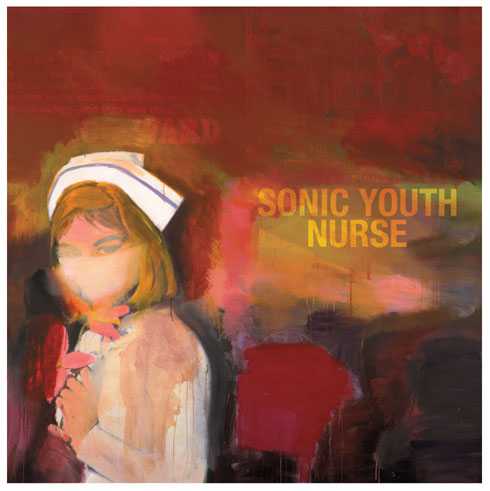
Such a high price for a photograph may be attributed to market whims. Prince’s stock in the art world has risen in recent years, enough to position the artist as number five on the top artists list of ArtReview magazine’s annual Power 100, released in November 2005, where he was previously unranked. Recent high-profile exhibitions at Barbara Gladstone Gallery in New York, work displayed in international art fairs, paintings appearing on a record cover, and interviews with or conducted by Prince in Artforum magazine have made him and his work on the tips of tongues. And Untitled (Cowboy), a large 50 x 70 inches, benefits from have the second edition in the collection of the Metropolitan Museum of Art. But the artist’s current market trendiness is not at issue here. In a larger sense, such a feat—the one million dollar mark—should have been cause for celebration for those who have tirelessly championed photography as art, but when considering the photograph in question—a tossed-off snapshot of a magazine page—an uneasiness sinks in.

Friday, November 9

Still Kicking It Till It Breaks

Karen Rosenberg, Art in Review, New York Times, November 9, 2007
“[Bozidar] Brazda’s work has looked sharp in group shows, including one at this gallery last summer and another at the Kitchen last spring, but he seems to have trouble sustaining focus on his own.”

Roberta Smith, Art in Review, New York Times, October 5, 2007
“Gardar Eide Einarsson’s work continues to be a little too thin on the outside and a little too hollow on the inside; it is more impressive in group shows than on its own.”

Tuesday, September 18

Honest responses

I love to read Artforum, and I love to read Frieze. They’re two of the best, most professional and thoughtful magazines on art around. The September issue of the latter has some particularly interesting reviews of recent exhibitions by Banks Violette and Dash Snow, perhaps some of the most insightful and bitingly funny commentary on these artists’ work. Both reviewers manage to criticize both the art and the art-world hype, shedding light on the vacuousness of the latter while taking a good look at the former, the actual stuff. You know, art. And what it’s all about.

Thursday, February 1

Global Warming in Frieze

The title of this post is no pun. A comment that appeared in this blog in September has found its way to the pages of a favorite British art magazine. Katie Stone Sonnenborn quotes from Daniel Lefcourt’s response to a post about his exhibition in her review of that same show. It’s in the second to last paragraph.

Thursday, November 9

Dennis Oppenheim review

My review of the recent temporary public-art exhibition of new work by Dennis Oppenheim has been published by the Brooklyn Rail. The work was deinstalled yesterday. I hope you were able to see it. Ace Gallery staged a miniretrospective in 2000 in its massive Hudson Street Street space, which was a real eye opener for someone like me who, until then, was only familiar with the artists late 1960s work. A lot of the work he does really makes me scratch my head, but his commitment to not creating an instantly recognizable body of work, unlike many of his peers, truly impresses me.

Wednesday, October 11

Critiquing the critics

On Tuesday night, the art historian and critic Donald Kuspit spoke at the School of Visual Arts. Tonight, Ken Johnson gave a talk at the New York Studio School. A prolific writer of articles and reviews and the author of dozens of books, Kuspit spoke on “Why Artists Hate Critics,” which was a provocative title for a pedestrian talk. I’ve never been a fan of Kuspit’s writing, which general cries out for an assertive editorial hand, and his often curmudgeon points of view. In a catalogue essay on the painter April Gornik, for example, he used the words “irony” or “ironical” throughout the text and seven times in one paragraph—and never ironically!

Kuspit’s talk was a total historiographic overload, filled with tissues of quotations and droppings of names that ranged from the usual suspects—Charles Baudelaire, Paul Gauguin, Wassily Kandinsky—to the more obscure, art historically speaking. Kuspit has a strong interest in psychoanalysis, so he brought up a number of psychologists. This is a grand oversimplification, but I came away with the knowledge that artists like to be told their work is great, and critics are the last bastion of free thought in art.

The Q&A session brought up the expected question about artists who write criticism, to which Kuspit said that the twentieth century, with its lack of common iconography (e.g., Christian) or style (e.g., Classical or Romantic), forced artists to defend their work in their own terms. Modernity was also, he noted, the grand age of manifestos. Kuspit did say that later generations of artists, Donald Judd in particular, boxed themselves into corners for negating the work of others in reviews instead of positioning their own work via print. I don’t think this point is as extreme as Kuspit makes it, as Judd, Dan Graham, Robert Morris, Mel Bochner, Robert Smithson, and many, many others—why stop at the 1960s?—were the ones who established the critical parameters for their production because hardly anyone else could.

Ken Johnson, a freelance writer for the New York Times and now art critic for the Boston Globe, came across as the aging ex-hippie. To him, art is to society as—in classic SAT form—dreaming is to the individual. He admitted in his talk, titled “Art, Criticism, and a Theory of Dreams,” that a critic is the interpreter of dreams, a person who searches for the transcendent and reconciles the irreconcilable. The artist, of course, does this too. Johnson favors modernist works of unity (e.g., from Pablo Picasso through John Chamberlain) in which the parts create an even greater whole, as well as works with richly metaphorical images that touch the heart and soul. Which, I think, is fine position to have but one that can’t deal with a lot of contemporary art, including the stuff that intrigues and often bugs me.

Johnson talked about pluralism in the art world, which he likened to an uninhibited creative psychic totality in which no type of art can really cancel another kind out. (He’s big into Carl Jung.) This point of view disagrees with Hal Foster’s notion of pluralism as the ostentatious presentation of commodities all appealing to different audiences or buyers, as well as a Foucauldian idea about power and sexuality. (I zoned out and can’t remember exactly what he said.)

Johnson then described a third strain of pluralism regarding images themselves—a Debordian notion, perhaps—in which images are so connected to products, and not to individuals, that the totality of imagination has been preempted. This pluralism he found in recent work by Kelley Walker and Seth Price. Johnson said he does not like this work but recognizes one of its aims, which is iconoclasm—a fear of images and the act of destroying them. Johnson rightly understands that this younger generation of artists sees total confusion in media today, in addition to an emptying of meaning in images, hence the artists’ iconoclastic attitude toward pictures and their pose of irony. This attitude, of course, goes beyond contemporary art. Walker’s recycling symbols demonstrate the redundancy of visual junk and image culture that have lost their meaning. Through incessant overuse, even secondary meanings get lost.

Johnson sees Walker and Price as trying to “imagine” their way out of a spectacular culture machinery that has so completely co-opted imagination. The only thing they can do is to destroy images and the control they exert over us. Unlike Johnson’s generation, ours doesn’t believe in escapism—tune in, turn on, drop out—although this fails to keep us from wanting to figure stuff out. Nihilistic? Certainly. What’s most interesting is that Johnson says this destruction brings back clear thinking. I really identify with this. Johnson still draws a line between the art he likes, which embodies metaphor, et al., and that which he respects but opposes: an art of critique. Two interesting points here: first he said the first postmodern artists, the Pictures generation, were both skeptical and romantic. Second, he noted that artists since then are more sympathetic to their elders—to those who taught theory and semiotics in the academy—than his sixties generation, which proverbially didn’t trust anyone over thirty. The audience at the New York Studio School, which I presume was art-conservative, was glad to hear this. They, too, are the bastions of freethinker about art and not slaves to theory.

I sat with my friend, the artist Jennifer Sullivan, whom Johnson wrote about in a review from a year ago. Her body of work—either thematically or content-wise—is probably the kind of art he would like: personal, searching, and earnest. But her materials and style are very much of this generation: not the criticality of Walker and Price, but rather slacker in appearance. This aesthetic, however, belies her boundless curiosity and wide-eyed enthusiasm.

Tuesday, October 10

Recent reviews

My review of Matt Freedman’s Twin Twin II and Matt Marello’s 1968 | 2001, both at Pierogi, appears in the October issue of the Brooklyn Rail.

Another review will be published in Art Notes, a magazine based in Santiago de Compostela, Spain, sometime in late November or early December. I have written, albeit briefly, on Nicola López’s work before in a review of The (S) Files at El Museo del Barrio about a year ago. (The paper’s editors introduced a factual error in the review: this was the museum’s fourth, not first, biennial.) The preedited text (300-word limit exceeded) of López’s current exhibition appears below.

Nicola López
OverGrowth
Caren Golden Fine Art
September 7–October 14, 2006

In the eastern United States, two types of climbing vines, called Chinese and Japanese wisteria, have been used to decorate gazebos and fences. If not carefully controlled, they quickly engulf surrounding trees, shrouding them in a thick web of greenery that physically chokes all underlying plant life and blocks out light—viciously killing everything underneath.

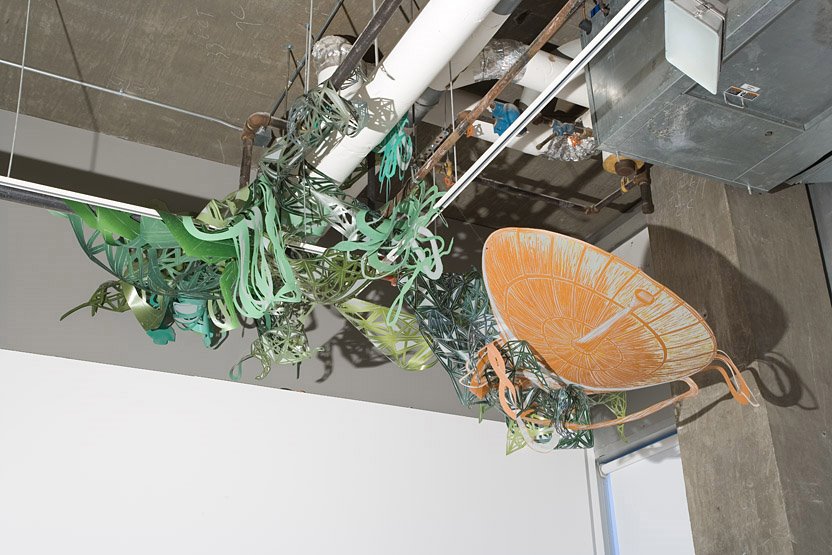
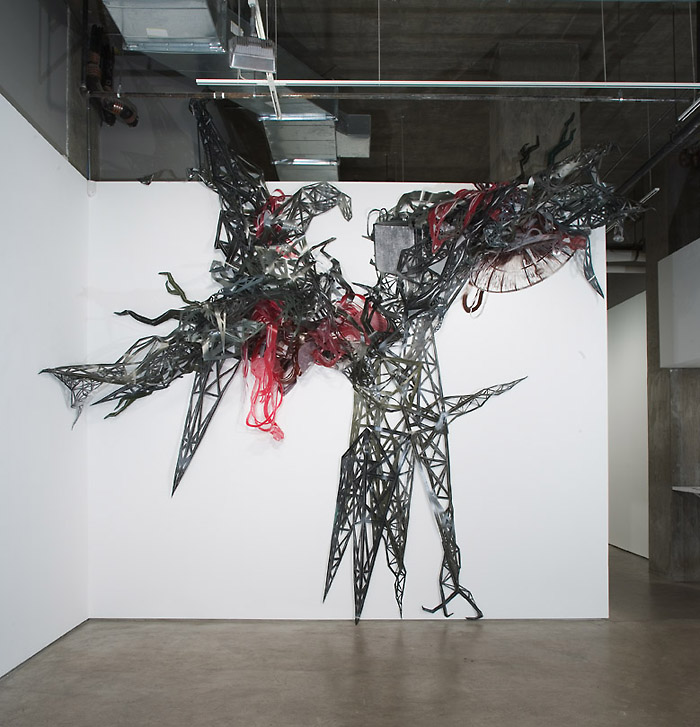
A parallel effect in the built environment can be found in Nicola López’s art. Her five installation works (consisting of woodblock and lithographic prints on Mylar), six mixed-media drawings, and one intaglio print depict a chaotic world of manmade technology—satellite dishes, television sets, steel towers, round pipes, and twisting cables—that has gone horribly awry.

Like the wisteria, her installations snake around the lighting tracks, heating pipes, and water ducts above the gallery walls, literally consuming the architecture. Wall-mounted steel armatures push forward more prints into the gallery space and spill onto the floor. While the industrial imagery in Blighted, Parasite, and Interloper spread like vicious vines, the loudspeakers and steel lattice towers of Mirage fail to curl, bend, and sway but instead hang strangely limp. Like its title, half of Under Its Own Weight sags to the floor, while its twin structure spikes skyward. Like the plant kingdom, even seemingly permanent structures have a limited life span.

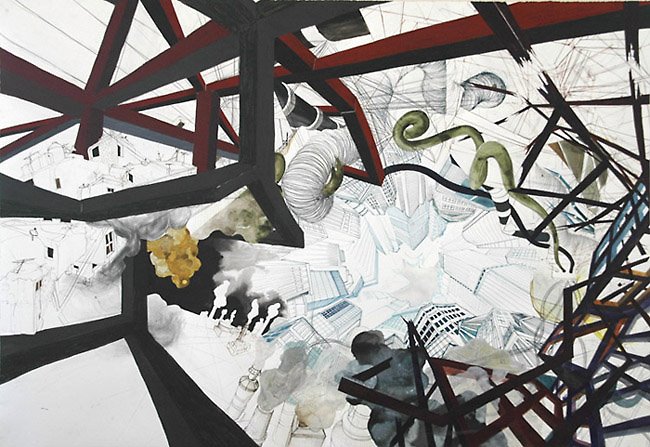
López’s chaotic drawings, with their occasionally awkward lines, portray industrial and urban scenes similar to the installations but in a more controlled fashion. Eye of the Storm shows a collapsing black hole of skyscrapers and smokestacks sucked inward with solid beams; other works depict pipes spew acrid smog and sewage among a labyrinth of machinery and factories. They’re ugly scenes, but it’s impossible to look away: there is beauty among the chaos. There is also an underlying sense of humor that pervades López’s work, but not so much a sense of hope.

López crucially chooses outmoded but not yet obsolete industrial infrastructure as the subject of her work. Compared to today’s advanced technology (think tiny cell phones or computer-aided architectural design), these steel towers and plodding satellite dishes are dinosaurs. Importantly, the uses and abuses of these leftovers have brought on environmental, social, and economic problems of the present.

Friday, July 21

Failures of the Interview: Nikki S. Lee

I’ve always felt that the artist’s interview is the best kind of reading about art, especially the standard Q&A format. Not only does the reader get the sense of an artist’s personality—and occasionally the interviewer’s—but he or she also hears first hand an artist’s intentions, attitudes, and feelings about the work. Of course, conducting a number of interviews myself and working as an editor, I realize that published interviews are often highly mediated: who really wants to wade through a direct transcriptions of “um”s and “err”s, awkward grammar, and incomplete sentences—not to mention incomplete thoughts. But still, that personality, that point of view directly from the source, always holds my interest.

In recent months I’ve become a fan of brief interviews published on the website artinfo.com, an affiliate of the magazine Modern Painters (which moved its offices from London to New York this summer). The website’s writers cover the entire range of art-world figures and personalities, including artists such as Luc Tuymans, Jim Dine, and Hiroshi Sugimoto, dealers Zach Feuer and Jeffrey Deitch, curators Okwui Enwezor and Klaus Ottmann, and administrators like Alexis Hubshman (Scope) and Robert Manley (Christies)—basically a who’s who of the contemporary art world. I check in with artinfo.com regularly, looking forward to each interview.

I was excited last month when an interview with the photographer Nikki S. Lee was published last month. I must admit that I’ve always had a problem with her work since first seeing and reading about it in the late 1990s. At that time she was working on her “Projects” series, in which the artist befriended a preexisting minority or social group, type, or clique (e.g., urban Latinos and blacks, yuppies, white trash, strippers, etc.) by dressing and (probably) acting like them in order to gain their trust. She then had her new friends take photographs of her with them in informal situations; these photographs were then exhibited.

My primary criticism is that her work so perfectly embodied the 1990s, a time when identity politics and critical theory all but replaced traditional art making and art history. Lee’s photographs complete the mental checklist of what's good in critical art—the snapshot aesthetic, the deskilling of the photograph (time and date stamp imprinted on the photo, which wasn’t even taken by the artist!), a minority artist depicting (mostly) minority groups or infiltrating majority ones, a destablilized, postmodern female identity—so completely that I can picture drooling art critics racing from the gallery to their desks to write about how her photographs subvert the dominant aesthetic and social paradigms. Collectors, perhaps encouraged by the art establishment’s garrulous praise as well as the booming market for photography—snatched up the work. The praise and sales kept coming. But it’s paint-by-numbers art.

I’m not saying that I smell as rat, because the identity politics, the formal aspects, the content and subject matter—it’s all there in the work. There's a lot to talk about. Identity politics, we know, has been an undeniably critical force in art, academia, and beyond and has opened so many doors and leveled the playing field. But really, Lee’s work simply illustrates all too easily, all too perfectly, what critics and theorists were discussing in the 1990s and even up to today. Lee's “Projects” series is essentially a glorified art-school assignment designed to maintain the academic and theoretical status quo. A familiar complaint, and not an unfounded one, against some art writers is that the work they write about seems only to serve the theories being engaged. Perhaps both the artist and the critics are painting-by-numbers, slapping each other’s back.

I mention all this by way of saying that nothing in her artinfo.com interview gives me reason to change my mind. She never truly clarifies her intentions in the “Projects” series and the work that comes after, while dodging valid interpretations of work under the guise of … I'm not sure.

For example, the interviewer Magdalene Perez asks:
There’s such a theatrical or cinematic element to much of your work. I have read that you picked up photography because you were ‘looking for a side door into film.
To which Lee responds:
I agree that there is probably a theatrical aesthetic in my work, but it’s not my intention. I would like a lot of layers in my work and if people see a theatrical element that’s fine. Some people see my work as snapshots or see a documentary aspect in my work. I like that people can see my work from different perspectives.
Okay. Of course art has different interpretations. Some valid, some arguable, some off the wall. We all know that. Yet in the next question, Lee brushes off what probably is the dominant interpretation of her work:
Your work is clearly about issues of identity, both personal and cultural.
Lee responds, and I can picture her getting a little worked up about this assertion (and, tellingly, not a question):
I don’t want to say my work is about identity or my work is about acting or about relationships. I don’t like to use just one word. I think it can be about many things. People say that it is about identity, but it’s too easy and too simple to say my work is about identity. It’s too limiting.
Lee’s work is about identity more than anything else. Her artistic strategy is so obvious, which may explain her defensiveness. But if there's something else going on, something deeper, well, I’d love to hear about it. A moment later Perez queries:
The Projects were probably compared to the work of Cindy Sherman about a million times. Were you influenced by her work, or do you feel you were doing something completely different?

This is about the millionth time, and I’m really, really tired of it.
Why might she be tired of it? She’s tired of it because the comparison is dead on. What shame is there in admitting an influence? Sherman is probably one of the most influential artists today, perhaps behind Marcel Duchamp and Andy Warhol. Lee’s work undeniably builds on Sherman’s “Untitled Film Stills” of the late 1970s, adding a deeper dimension of identity politics. But she apparently doesn’t think it's important enough to articulate. Still more:
In the 1990s you studied at the Fashion Institute in New York and later worked as a fashion photographer’s assistant. How do you think studying within the fashion genre has influenced your work?

Not at all. I feel it’s not related to my work in any way.
Lee’s more recent “Parts” series depicts the artist posing in various dress and in varying locations, for example, in a taxi, a swanky apartment, and a pawn shop. Body parts of a man—a leg, arm, or shoulder, and never a face—are visible, but a whole, recognizable person never is. Similarities are present: social class and female identity and independence are address, for instance. But the series is undoubtably referencing, in some way, fashion photography. The difference between the “Projects” and “Parts” is that the latter group of photographs are highly stylized with high production values. These photographs distinctly resemble fashion-magazine editorial spreads, with the main difference being that the brand names or prices of clothing aren’t listed on a wall label or caption. The “Parts” series, we learn from Lee, was a commissioned work, although it’s unclear who commissioned the photographs and for what purpose. Lee says:
Those pictures … It was all commissioned work. So it doesn’t reflect so much on my other work. In terms of fashion or other statements, there’s nothing I am trying to say – there’s nothing related to the concept of the “rich life” or something [to that effect]. I was just invited to do it, that’s it.
So the work neither critiques nor celebrates its subject, nor does it sell anything as a fashion spread does—it just is.

Finally, the interviewer asks in which direction Lee might be headed. The artist says:
I cannot say anything right now because I don’t want to have any limitation. I don’t have any idea what I might do. I can even do painting or sculpture, who knows.
Lee’s obsession with avoiding limitations, pigeonholing, and labels overshadows anything meaningful she has to say about her work. Wait—she actually doesn’t have anything meaningful to say about her work. Such a noncommittal attitude makes me wonder exactly why Lee is making art at all.